A DOT physical is the medical examination the Federal Motor Carrier Safety Administration requires to confirm that a commercial motor vehicle driver is physically, mentally and emotionally fit to drive safely. It has to be performed by an examiner listed on the FMCSA National Registry, and it includes a vision test, a hearing test, a blood pressure and pulse check, a urinalysis and a full hands-on physical examination.
Pass all of it and the examiner certifies you as qualified and issues your Medical Examiner’s Certificate. Here is exactly what happens at each step, who is required to take the exam, how long the certificate lasts, and where to get it done by a certified DOT medical examiner in Tampa without complications.
Who needs a DOT physical?
You need a DOT physical if you operate a commercial motor vehicle, and the threshold that catches most people out is weight rather than licence type. Specifically, you need one if you drive a vehicle with a gross vehicle weight rating of 10,001 pounds or more, if you transport 16 or more passengers including yourself, if you are paid to drive a vehicle designed to carry 9 or more passengers, or if you carry hazardous materials in quantities that require placards.
Note what is not on that list: holding a CDL. Plenty of drivers who never needed a commercial licence still need a medical card, because their box truck or their crane crosses the 10,001-pound line. If that is you, the paperwork also works differently for you, and we cover why further down.
What the DOT physical exam actually covers, test by test
The Federal Motor Carrier Safety Administration sets the exact components of the exam under 49 CFR Part 391. Every certified medical examiner follows the same checklist, regardless of where you go, and records the result on the Medical Examination Report, Form MCSA-5875. Here is what that checklist looks like in practice.
Vision test
You need at least 20/40 visual acuity in each eye, with or without corrective lenses, distant binocular acuity of at least 20/40 in both eyes together, and a field of vision of at least 70 degrees in the horizontal meridian in each eye. You also need to be able to distinguish between red, green and amber, the colors of traffic signals. If you wear glasses or contacts, bring them. The examiner tests each eye individually and both together.
Drivers who do not meet the standard in the worse eye may qualify under the FMCSA’s alternative vision standard, introduced in 2022 as 49 CFR 391.44, which allows certification with a Vision Evaluation Report (Form MCSA-5871) completed by an ophthalmologist or optometrist no more than 45 days before the exam.
Hearing test
The examiner checks whether you can hear a forced whisper in your better ear from at least 5 feet away, with or without a hearing aid. If you do not pass the whisper test, audiometry is the alternative: average hearing loss in the better ear must not exceed 40 decibels at 500, 1,000 and 2,000 Hz. If you use a hearing aid, you must wear it every time you operate a commercial vehicle, and the examiner will note this on your certificate.
Blood pressure and pulse
Blood pressure is one of the most common reasons drivers get a shorter certification period rather than the full two years. The FMCSA medical advisory criteria, which guide the examiner rather than bind them, work like this:
- Below 140/90: two-year certificate, no conditions
- 140/90 to 159/99: one-year certificate, treatment recommended
- 160/100 to 179/109: temporary 3-month certification to allow treatment
- 180/110 or above: disqualified until controlled
Your pulse is also recorded, and the examiner checks for irregular heartbeat. If you take blood pressure medication, keep taking it as prescribed before your exam. Stopping it to «reset» your reading is both medically risky and unlikely to help.
Urinalysis
You provide a urine sample that is analyzed for protein, blood, sugar and specific gravity. This is a screening tool for underlying conditions like diabetes or kidney disease, not a drug test. Specific gravity matters more than drivers expect: a very dilute sample makes the other three readings unreliable, so arriving dehydrated can mean giving a second sample.
Full physical examination
Beyond the specific tests above, the certified medical examiner performs a thorough head-to-toe physical that covers:
- General appearance, including signs of fatigue, tremors, or substance use
- Mouth and throat
- Heart and cardiovascular system
- Lungs and chest
- Abdomen
- Spine and musculoskeletal structure
- Neurological reflexes
- Extremities, including range of motion and grip strength
If the examiner identifies a condition that needs further review, such as a heart murmur, signs of sleep apnea, or an abnormal neurological finding, they may require additional documentation before issuing your certificate. This is not a disqualification; it is a request for more information, and you have 45 days to provide it.

Is a drug test part of the DOT physical?
No. The urinalysis in the DOT physical screens for protein, blood, sugar and specific gravity, not for controlled substances. The DOT drug test is a separate procedure under 49 CFR Part 40, normally ordered by your employer, with its own collection process and its own laboratory. We go into the panel, the cutoff levels and what happens after a positive result in our guide to whether they drug test at a DOT physical.
What will make you fail a DOT physical?
Very little disqualifies a driver permanently. The three failures that actually happen on the day are blood pressure above 140/90, uncontrolled blood sugar, and vision or hearing that falls short without the right correction. All three are fixable, and none of them ends a career.
The conditions drivers worry about most, insulin-treated diabetes, sleep apnea, a seizure history or a past cardiac event, do not disqualify you automatically either. What they require is documentation from your treating physician, and sometimes a shorter certification period. The real risk is not the condition: it is arriving without the paperwork that condition needs.
How long does the DOT physical take?
For most drivers without pre-existing conditions, the exam takes between 30 and 45 minutes from the moment you sit down with the examiner. If you arrive with all your documents ready and have no conditions requiring additional evaluation, it can be closer to 30 minutes. At Medical Exams of Tampa, the CDL medical exam is performed by an ARNP with over 10 years of experience specifically in DOT exams, which means the process is efficient and the examiner knows exactly what to look for.
If additional documentation is needed (a stress test for a heart condition, a sleep study for suspected sleep apnea, or a specialist form for insulin-treated diabetes) expect a second visit. This is why arriving prepared matters.
How long is your DOT medical card valid?
The maximum certification period is 24 months. It drops to 12 months if you have diabetes treated with insulin, if you are certified under the alternative vision standard, or if you drive only within an exempt intracity zone, and the examiner can issue a shorter period whenever a condition needs closer monitoring. A 3-month certificate for blood pressure is common and is not a black mark on your record.
There is no federal grace period once it expires. An expired card means your CDL is no longer valid for commercial driving until you recertify, and your state may downgrade the licence depending on how long it has lapsed. Renewing early does not shorten the new period, which runs from the date of the new exam.
Your medical card is now transmitted electronically
Since June 23, 2025, certified medical examiners must transmit CMV driver exam results electronically to the FMCSA National Registry by midnight local time of the next calendar day, and the FMCSA forwards that information to your State Driver’s Licensing Agency, which posts it to your CDLIS motor vehicle record. This is the National Registry II rule, and for CDL and CLP holders it replaces the old routine of hand-delivering a paper card to the state.
Two details follow from it that most guides have not caught up with. A CDL or CLP holder with a current certificate is no longer required to carry the certificate on their person while on duty. And if the information the FMCSA provides electronically conflicts with your paper copy, the electronic information controls. Both are written into 49 CFR 391.41(a)(2).
The transition is not finished. A temporary FMCSA exemption running to October 11, 2026 still allows drivers and carriers to rely on a paper copy of Form MCSA-5876 for up to 60 days after issue, and the FMCSA has said it does not anticipate granting further nationwide exemptions. Non-CDL drivers are outside all of this: the examiner still issues them a paper certificate and they still carry it.
The practical takeaway: keep whatever paper certificate you are given, and pull your own motor vehicle record a week or two after the exam to confirm your medical status posted correctly. Being certified and having your record show it are two different things.
What happens if you show up without the right documents?
This is one of the most common and avoidable problems in the DOT physical process. If you show up without the documentation your condition requires, the examiner cannot complete your certification that day. Specifically:
- Insulin-treated diabetes: you need Form MCSA-5870 completed by your treating physician no more than 45 days before the exam. Without it, you cannot be certified on that visit.
- Heart disease or coronary history: a recent stress test or cardiologist clearance may be required. The examiner will tell you what they need, but you will have to come back.
- Sleep apnea diagnosis: if you are being treated for sleep apnea, bring documentation showing compliance with your CPAP therapy. Untreated sleep apnea can result in a temporary disqualification.
- Medications: if you cannot provide a complete list of your current medications with dosages and prescribing doctors, the examiner may not be able to rule out disqualifying drug use.
The fix is simple: call the clinic before your appointment and go through your health history with the staff. They will tell you exactly what to bring.

What to bring to pass on your first visit
- Valid photo ID (driver’s license or passport)
- Complete list of current medications with dosages and prescribing physician names
- Eyeglasses, contact lenses or hearing aid if you use them
- Relevant medical records: surgical history, specialist reports, or ongoing treatment documentation
- Specialist forms if required: MCSA-5870 for insulin-treated diabetes, MCSA-5871 for the alternative vision standard, sleep study results if applicable
- Do not empty your bladder right before the exam, since you will need to provide a urine sample
Where to get your DOT physical in Tampa
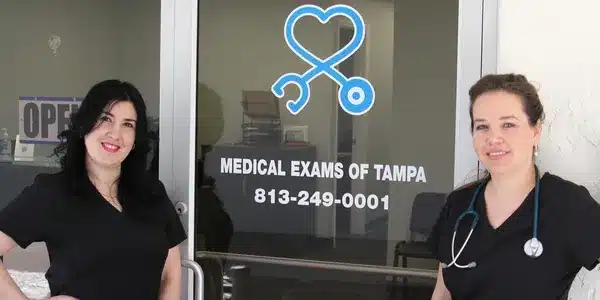
Medical Exams of Tampa specializes exclusively in physical exams. This is not a general urgent care clinic that does DOT exams on the side: the team is built around certifications, and the ARNP performing your exam has over a decade of experience specifically with CDL medical exams. The staff is bilingual in English and Spanish, which makes a real difference for many drivers in the Tampa area who prefer to go through the health history questionnaire and the exam itself in their first language.
The clinic accepts walk-ins Monday through Friday from 8:30am to 4:30pm, and is located at 7345 Jackson Springs Rd, Suite C3, Tampa, FL 33634. The DOT physical costs $100, and the clinic holds a 5.0 rating from 237 Google reviews. You can book your CDL medical exam in Tampa by phone at 813-249-0001 or schedule online.