A civil surgeon is a licensed physician officially designated by U.S. Citizenship and Immigration Services (USCIS) to perform immigration medical examinations inside the United States. If you are applying for a green card or adjustment of status, you cannot use your regular doctor for the required exam. It must be performed by a physician on the official USCIS civil surgeon list, and the results must be recorded on Form I-693.
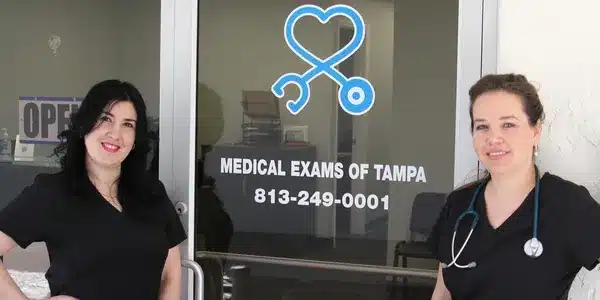
If you are in the Tampa Bay area and need a certified immigration medical exam in Tampa, Medical Exams of Tampa is a USCIS-designated civil surgeon office with bilingual staff.
Why the term «civil surgeon» exists
The term dates back to the Immigration Act of 1891. Before that, all arriving aliens were examined by surgeons of the Marine Hospital Service, a federal agency. When those surgeons were unavailable, Congress authorized licensed private physicians to step in. They were called civil surgeons to distinguish them from military and public health service doctors.
Today, U.S. Public Health Service officers rarely perform these exams. Civil surgeons handle virtually all immigration medical examinations required of applicants already inside the United States, under authority granted by the Immigration and Nationality Act of 1952 and updated by the Homeland Security Act of 2002.

What qualifies a doctor to be a civil surgeon
Not every licensed physician qualifies. USCIS requires all three of the following:
- A degree as a Doctor of Medicine (M.D.) or Doctor of Osteopathy (D.O.)
- An unrestricted license to practice medicine in the state where the exams are conducted
- At least four years of professional medical experience after completing all postgraduate training
That last point matters: internships and residencies do not count toward the four years. The clock only starts once postgraduate training ends. A fellowship, however, does count since it is not required as part of standard training.
Registered nurses, nurse practitioners, physician assistants, chiropractors, and other healthcare workers cannot be civil surgeons, even if they are highly qualified in their own fields. If someone at a clinic other than the designated M.D. or D.O. performs your exam and signs the form, USCIS will reject it.
To become designated, a physician applies to USCIS using Form I-910. Since 2014, USCIS has centralized the process to maintain consistent standards across all designated providers.
Civil surgeon vs panel physician: not the same thing
Both conduct immigration medical exams, but for different applicants in different situations.
A civil surgeon works with applicants who are already inside the United States and are applying for adjustment of status (Form I-485). The completed Form I-693 is submitted directly to USCIS.
A panel physician is designated by the U.S. Department of State, not USCIS. Panel physicians work at U.S. embassies and consulates abroad and conduct exams for applicants going through the visa process outside the country. Their results go directly to the embassy, not to USCIS, and are recorded on different forms.
If you are filing from inside the United States, you need a civil surgeon. A panel physician cannot complete your I-693, and vice versa.
What a civil surgeon does during the exam
The civil surgeon follows Technical Instructions issued by the Centers for Disease Control and Prevention (CDC). These instructions are updated regularly and dictate exactly what must be examined, tested, and recorded.
During the appointment, the civil surgeon reviews your medical history, performs a physical examination, orders required laboratory tests (including QuantiFERON-TB Gold for tuberculosis and blood tests for syphilis and gonorrhea for applicants 15 and older), evaluates your vaccination history, and determines whether any conditions make you inadmissible under U.S. immigration law.
The four categories that can affect admissibility are communicable diseases of public health significance, failure to show proof of required vaccinations, physical or mental disorders with associated harmful behavior, and drug abuse or addiction.
After completing all components, including any required referrals or follow-up, the civil surgeon records findings on Form I-693, signs and seals it in an envelope, and gives it to you to submit with your I-485. For a detailed breakdown of every part of that form, see the complete guide to Form I-693 instructions.

What happens if your civil surgeon loses their designation
USCIS can revoke a civil surgeon’s designation at any time for failing to meet responsibilities, such as not following CDC Technical Instructions, not reporting contact information changes within 15 days, or other compliance failures.
If your civil surgeon’s designation is revoked after completing your exam but before you submit your application, USCIS may not accept the form. A revoked civil surgeon is required to inform patients that they can no longer complete immigration medical exams, but this does not always happen promptly. This is one reason to verify designation status before your appointment, not just before scheduling.
You can confirm current designation status using the USCIS «Find a Civil Surgeon» tool at uscis.gov/tools/find-a-civil-surgeon. Search by zip code and confirm the physician’s name appears on the list at the time of your appointment.
How to get your certified immigration medical exam in Tampa
Medical Exams of Tampa is a USCIS-designated civil surgeon office located at 7345 Jackson Springs Rd, Tampa, FL. The base exam is $270 for adults and $220 for children, and includes the physical examination, QuantiFERON-TB Gold blood test, vaccination record review, and the completed, sealed Form I-693. The office has bilingual staff.
To book your certified immigration medical exam in Tampa, visit medicalexamstampa.com/immigration-exams or call 813-249-0001.