Form I-693 is the official USCIS document (formally called the Report of Medical Examination and Vaccination Record) that a designated civil surgeon completes to certify that you do not have health conditions making you inadmissible to the United States. The form itself has no filing fee. Your job as an applicant is to show up prepared, fill out your personal information in advance, sign in front of the civil surgeon, and submit the sealed result with your I-485 application.
If you are preparing for your green card medical exam and want to make sure the process goes right the first time, this guide breaks down every section of the form, the rules USCIS will not bend on, and what to bring. If you are in Florida, our immigration medical exam in Tampa include the completed, sealed I-693 with bilingual staff.
What Form I-693 actually is (and what it is not)
Form I-693 is not a health certificate that says you are healthy. It is a structured report that documents whether specific conditions are present: communicable diseases of public health significance, physical or mental disorders associated with harmful behavior, and substance use issues. Having a chronic illness, taking regular medication, or having a history of mental health treatment does not automatically disqualify you.
The form is completed almost entirely by the civil surgeon. You fill in your personal information and sign in the civil surgeon’s presence, but every medical finding, vaccination assessment, and certification comes from the physician.

Who can complete it, and why your regular doctor cannot
Only a physician officially designated by USCIS as a civil surgeon may perform the exam and complete Form I-693. This designation requires specific USCIS training and approval. Exams conducted by your primary care doctor, a general practitioner, or any unlisted physician will be rejected by USCIS outright, no matter how thorough the exam was.
You can search the official USCIS civil surgeon locator at uscis.gov/tools/find-a-civil-surgeon to confirm that your chosen office is currently on the list before scheduling.
How Form I-693 is structured, and what you complete
The form has 11 parts in total. As an applicant, you are responsible for two of them. The civil surgeon and any referred health care providers complete the rest.
What the applicant completes
Part 1: your personal information. Complete this before arriving at your appointment. It includes your full legal name, date of birth, address, A-Number (if you have one), and USCIS Online Account Number. Write in capital letters using black ink, or type. Do not sign or date the form in advance. Your signature goes in Part 2 and must happen in the civil surgeon’s physical presence. Signing early is a common mistake that forces applicants to return for a corrected form.
Part 2: your certification and signature. You indicate whether you read the form yourself or used an interpreter or preparer, and you sign and date here. If you used an interpreter, that person completes Part 3. If someone helped you prepare the form, they complete Part 4.
What the civil surgeon completes
Part 5: identity verification. The civil surgeon records the ID you presented.
Part 6: summary of overall findings. Completed after the full exam and any required follow-up. The civil surgeon cannot sign the form until all follow-up requirements are met.
Part 7: civil surgeon certification and signature. The official sign-off. Must be an original ink signature; stamped or typewritten names are not accepted (except for blanket-designated health departments or military physicians).
Parts 8 and 9: civil surgeon worksheet and referral evaluation. Detailed findings from each component of the exam, plus documentation if a referral to another provider was required.
Part 10: vaccination record. The civil surgeon documents each required vaccine: whether you have documentation, whether they administered it, and whether a titer confirmed immunity.
What the medical exam evaluates
The civil surgeon screens for four categories of conditions relevant to U.S. immigration law.
Communicable diseases. All applicants two years and older are tested for tuberculosis using a QuantiFERON-TB Gold blood draw. If the result is positive, a chest X-ray follows. All applicants 15 and older have a blood test for syphilis and are also tested for gonorrhea. The civil surgeon also evaluates for other sexually transmitted diseases and Hansen’s disease (leprosy).
Physical and mental disorders. The civil surgeon evaluates for disorders associated with harmful behavior toward the applicant, others, or property. A diagnosis alone does not make you inadmissible. What matters is whether current or likely-recurring harmful behavior is associated with it.
Drug abuse and addiction. The civil surgeon reviews your medical history and asks about current or past substance use. Conditions in remission, documented by a subsequent civil surgeon exam, can remove this ground of inadmissibility.
Vaccination history. Covered in detail in the next section.
For a full breakdown of what the physical exam covers and what Class A versus Class B findings mean for your application, see the complete guide to what’s included in the immigration medical exam.
The vaccination record (Part 10)
The civil surgeon reviews your immunization history and records which required vaccines you have documentation for, which you received at the appointment, and which titer tests confirmed immunity. Required vaccines include MMR, polio, tetanus-diphtheria-pertussis, Haemophilus influenzae type B, hepatitis A and B, varicella, meningococcal, and seasonal flu (if the exam takes place between October 1 and March 31). The COVID-19 vaccine is no longer required as of January 20, 2025.
Bring your complete vaccination records in hard copy. If they are in a language other than English, you must also bring a certified translation. The translator must sign a statement confirming the translation is complete and accurate, along with their printed name and the date. An uncertified translation is not sufficient under USCIS rules.
If you are missing documentation for certain vaccines, do not try to get vaccinated before your appointment. The civil surgeon evaluates you first to determine which vaccines are appropriate for your age and health before administering or directing you to get them. Some vaccine requirements can also be waived if they are not medically appropriate for you.

The edition date matters: make sure your civil surgeon uses the 01/20/25 version
USCIS updates Form I-693 periodically, and using an outdated edition results in rejection. As of July 3, 2025, USCIS accepts only the 01/20/25 edition. If your civil surgeon signed the form on or before July 2, 2025, the 03/09/23 or 01/20/25 editions were both acceptable. After that date, only the most recent edition is valid.
This is a detail most applicants never think to check, but a wrong edition date means returning to the civil surgeon to redo the entire form. A well-run office tracks these updates automatically. It is worth confirming before your appointment.
The sealed envelope rule: the one mistake that gets forms rejected
Once the civil surgeon signs and seals Form I-693, do not open the envelope under any circumstances. USCIS will reject a form that arrives in an unsealed, opened, or altered envelope, with no exceptions. The civil surgeon writes «DO NOT OPEN. FOR USCIS USE ONLY» on the front and initials the seal on the back before giving it to you.
The civil surgeon must also give you a separate unsealed copy of the completed form for your own records. Review that copy carefully. If you spot an error (a wrong date of birth or a misspelled name), contact the civil surgeon before submitting anything. The physician can void the sealed form, issue a corrected one, and re-seal it. This is far better than submitting a form with errors and receiving a Request for Evidence from USCIS months later.
When to submit Form I-693 with your I-485
As of December 2, 2024, USCIS requires Form I-693 to be submitted at the same time as Form I-485. You cannot file I-485 and submit the medical exam later. Sending them separately will result in rejection of your I-485 application.
If you are filing Form I-485 online through the USCIS website, you must open the sealed envelope from the civil surgeon and upload the completed Form I-693 digitally with your application. If you are filing by mail, submit the sealed envelope inside your I-485 package without opening it.
How long is Form I-693 valid?
A Form I-693 signed by the civil surgeon on or after November 1, 2023, does not expire. It remains valid for any future immigration benefit application, unless USCIS has reason to believe your medical condition has changed and requests a new exam. If your form was signed before November 1, 2023, it was valid for two years from the signing date.
One practical note: even though the form does not expire, if your application is denied or withdrawn, you will need a new exam for any future filing.
What to bring to your appointment so the form goes right the first time
- Government-issued photo ID (unexpired passport or driver’s license)
- Complete vaccination records, printed in hard copy
- Certified English translation of any records not in English
- Documentation of any prior positive TB or syphilis tests, including chest X-rays and treatment records
- List of current medications
- Form of payment (health insurance does not cover immigration exams)
You do not need to fast. The blood tests performed at the immigration medical exam screen for infectious diseases, not glucose or cholesterol, so food and drink before the appointment do not affect results.
Schedule your I-693 exam in Tampa
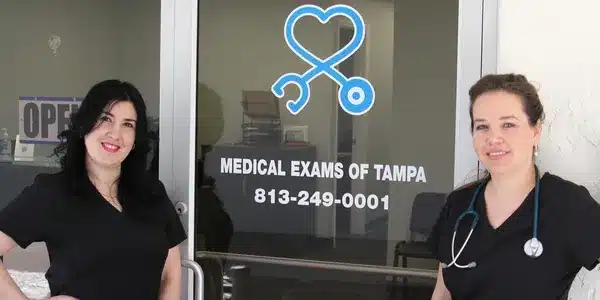
Medical Exams of Tampa is a USCIS-designated civil surgeon office serving the Tampa Bay area. The base exam for adults is $270 and includes the physical, QuantiFERON-TB Gold blood test, vaccination record review, and the completed, sealed Form I-693. Children’s exams start at $220. The office uses the current edition of Form I-693, offers bilingual staff.
To book your immigration medical exam in Tampa, visit us or call 813-249-0001.